







Is the Forward Pass Law being relaxed.
On 26 April 2023, The Daily Telegraph reported that Premiership referees and TMOs (television match officials) were being instructed to be far more conservative in calling a forward pass, with guidance to avoid flagging marginal or debatable forward-pass incidents unless they are blindingly obvious. This effectively acknowledges how subjective forward-pass decisions can be in modern rugby officiating, especially given the physics involved in how the ball travels relative to players at speed.
Although the full text of the Telegraph article is behind a paywall, the thrust of the reporting was that officials have been advised to leave marginal forward-pass decisions alone, particularly where it is not clear that the passer actively threw the ball forward. The Telegraph
What the Rugby Forward Pass Law Actually Says (World Rugby Law 2023)
Under the World Rugby Laws of the Game (2023 version):
Law 11 – Knock forward or throw forward defines a forward pass as follows:
-
A throw forward may occur anywhere in the playing area.
-
A player must not intentionally throw or pass the ball forward (towards the opposition’s dead-ball line).
-
The usual sanction for a throw forward is a scrum (or, if intentional, a penalty). passport.world.rugby
Importantly, the law itself does not contain any wording about relative velocity or momentum — but referees’ interpretation does. passport.world.rugby
Relative Velocity — Physics Meets the Law
In practice, referees (and the TMO) generally judge a forward pass by the direction of the ball relative to the passer’s hands at the moment it leaves them, not by the position where the receiving player catches the ball. This is where relative velocity comes in:
-
A player can be running forward at pace.
-
If they release the ball with a backward or lateral motion relative to their own body, the initial pass is legally backward.
-
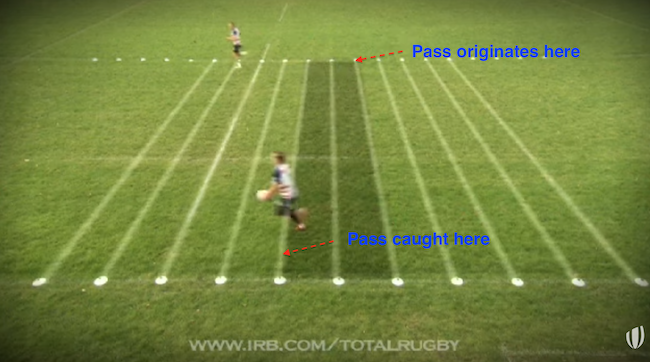
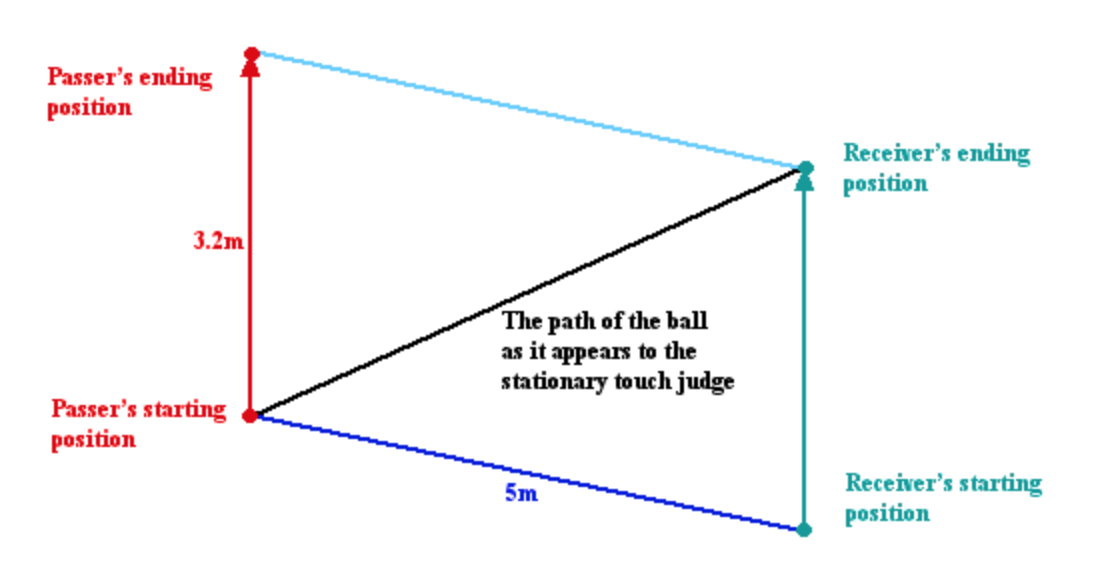
Because the passer’s forward momentum is carried into the ball, the ball may still travel forward relative to the ground and be caught ahead of the passing point.
-
As long as the ball left the passer’s hands going backwards or flat relative to the passer, the pass is legal — even if the receiver catches it further forward on the pitch. The Guardian
This is often described in refereeing and law interpretation as due to relative velocity — the vector addition of the passer’s forward speed and the actual backward motion imparted to the ball. The Guardian
Cambridge University physics provides an intuitive analogy: a ball thrown backward from a moving vehicle will still move forward relative to the ground if the vehicle’s speed is greater than the backward component of the throw — yet the motion relative to the thrower can still be backward overall.
Why a Forward Pass Can Be Caught Ahead of the Passer
Because the Law looks only at the direction of the pass relative to the passer, not the relative positions of passer and receiver at the catch, it can—and often does—happen that:
-
The receiver catches the ball further upfield than the point of release, yet the pass is not forward under the laws.
-
In broadcast replays, this often looks like a forward pass because the ball travels toward the opponents’ try-line. The Guardian
This has been a source of confusion among fans and commentators, hence why the Telegraph story highlighted the reluctance of officials to intervene on close calls. The Telegraph
Rumoured or Prospective Forward Pass Law Revisions (Post-2023)
World Rugby has been actively trialling and adjusting laws to improve clarity and spectacle, including changes unrelated to forward-pass physics (e.g., offside from kicks and tackle laws), but there hasn’t been a specific rewrite of the forward-pass law in 2023 to include relative velocity wording. What has been implemented or trialled is:
-
A revised TMO protocol that gives officials greater clarity on when to intervene for final attacking decisions (including potential forward passes). World Rugby
However, the core wording of Law 11 (throw forward) — focusing on intentional forward passes — remains unchanged in the 2023 laws. passport.world.rugby
Putting It Together — Why the Telegraph’s Point Matters
When explaining forward passes and relative velocity to readers:
-
The Telegraph’s reporting captures the officiating reality — that referees and TMOs are cautious about ruling forward passes where interpretation is subjective. The Telegraph
-
World Rugby’s law (Law 11) is clear that a pass cannot be intentionally forward, but says nothing about motion physics. passport.world.rugby
-
Relative velocity explains why a pass can be caught ahead of the release point and still be legal — the classic example of a ball leaving the hands backward relative to the passer is key. The Guardian
This explanation helps readers understand why optical illusions on TV replays often fuel controversy, and why the laws themselves prioritise the intention and mechanics of the pass over the absolute positions of players when the catch is made.
Explanation of the Forward Pass Law in a Video